Showing posts with label Astronomy. Show all posts

Thursday, November 28, 2013

Mysterious Hexagon on the Planet Saturn

Saturn is the sixth planet from the Sun and the second largest planet in the Solar System, after Jupiter. Named after the Roman god of agriculture, Saturn. Saturn is probably best known for the system of planetary rings that makes it visually unique. But there is also another unique and wonderful matter about this planet " The Mysterious Hexagon".


This mysterious hexagon is a persisting hexagonal cloud pattern around the north pole of Saturn. The sides of the hexagon are about 13,800 km (8,600 mi) long, which is longer than the Earth's diameter.The hexagon was originally discovered in images taken by the Voyager spacecraft in the early 1980s.

The hexagon, according to NASA, is 60 miles thick (deep) and an astonishing 15,000 miles wide.That means four Earths would fit inside it. Nasa’s Cassini spacecraft, which has been orbiting the planet for over nine years, has captured the northern hexagon in its true, incredible colours. The hexagon is made of a band of upper-atmospheric winds which creates its six-sided shape. A polar cyclone can be seen at its centre. Thin, bright clouds at the outer edge of the hurricane were estimated to be travelling at around 330 mph (150 meters per second).

Monday, May 20, 2013

The Great Red Spot (GRS) of Planet Jupiter

Planet Jupiter is the biggest and fifth planet of our solar system. This gigantic planet was named by the Romans after the king of the gods, Jupiter. Jupiter is one of five planets that can be seen by the naked eye (Mercury, Venus, Mars and Saturn are the other four); in fact, it is the second brightest planet after Venus. Among all its facts and features the most prominent and well-known feature of the planet Jupiter is the Great Red Spot (GRS) but it is not Jupiter's surface feature.

Planet Jupiter and its Great Red Spot
Jupiter's Great Red Spot nothing but is a huge, long-lasting spinning storm in the atmosphere of the Southern Hemisphere of Jupiter. It is an anti-cyclonic (high pressure) storm, much like a gargantuan hurricane. Its color is actually pink to orange. This whirlwind varies in size and color from year to year. This spinning storm is the biggest storm of our solar system. The smaller white spots are also giant storms. The colors we see are the result of chemical reactions occurring in the atmosphere.

Great Red Spot, the biggest storm of the solar system
The storm is so big that it is about 17,000 miles (28,000 km) long and 9,000 miles (14,000 km) wide and  in fact, three Earths wouldn't cover the Giant Red Spot completely.

Earth and Great Red Spot

Earth and Jupiter
Giovanni Cassini was the first to observe it in the late 1600s, from 1665 to 1713, so the Spot is pre-dates at least the time of Galileo in the 1600s, when humans first began using telescopes to observe the heavens. That means this particular storm has been raging continuously for over 400 years. Certainly the composition of Jupiter's atmosphere, the planet's density, mass and volume all contribute to the storm's longevity and there is speculation that the Spot's noticeable red color is due to a higher concentration of phosphorus within the storm.


Saturday, May 18, 2013

Olympus Mons | The highest known mountain in our solar system

Olympus Mons
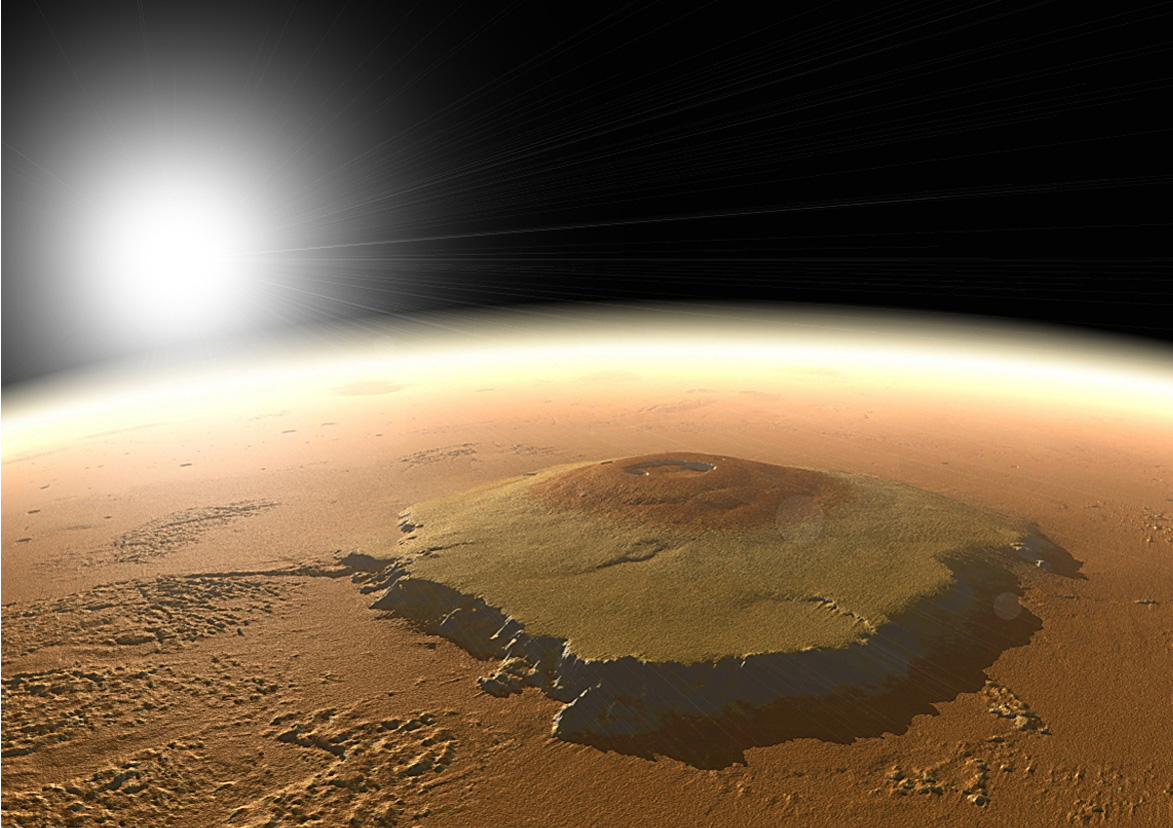
Olympus Mons is the largest and the tallest known shield volcano(volcano which is almost entirely built of fluid lava flows) and mountain in our solar system. This gigantic mountain is in the red planet Mars. Olympus Mons is located in Mars's western hemisphere.

Olympus Mons
Olympus Mons
Olympus Mons height nearly 27km above the surface of Mars and 624km wide.It gets its name from Mt. Olympus, which was home of the Greek Gods. Olympus Mons is as wide as the state of Arizona and almost 3 times taller than Mt. Everest. The Hawaii Island, Maui would fit inside its huge caldera.


The main reason for it being large, could be the lower surface gravity in Mars accompanied by the higher eruption rates. This could be why there are many volcanoes in Mars which are more than 10 times the size of the volcanoes in Earth. Another reason could be the fact that the crust doesn't move in Mars which is different to Earth where the plates move. This means that the lava piles up to form a huge volcano whereas in Earth the lava will be used to make new volcanoes rather than making the same volcano bigger as the plates move.

Valles Marineris | Gigantic valley of Mars

Telescope view of Valles Marineris
The terrestrial red planet Mars is the most attractive and researching plane for the astronomers. It surface features are very attractive and magnificent. Among the diversified surface feature, one of  most incredible diversity is the Valles Marineris. This valley stretches for nearly a quarter of the planet’s circumference.

close view of Valles Marineris
Valles Marineris which was discovered in 1971–72, is a system of canyons that runs along the Martian surface east of the Tharsis region of Mars. Valles Marineris rift system is one of the larger canyons of the Solar System, surpassed only by the rift valleys of Earth and (in length only) by Baltis Vallis on Venus.

close view of Valles Marineris

This gigantic valley is about 2,500 miles (4,000 kilometers) long and varies from 2.5 to 6 miles (4 to 10 kilometers) in depth. By comparison, Earth's largest canyon, the Grand Canyon in Arizona is only 277 miles (446 kilometers) long and 1 mile (1.6 kilometers) in depth.

Wednesday, January 23, 2013

Biggest Satellites of our Solar System

1. Ganymede

Ganymede is a satellite of Jupiter and the largest moon in the Solar System. It is larger than Mercury and Pluto, If Ganymede orbited the sun instead of orbiting Jupiter, it would easily be classified as a planet. Ganymede's discovery is credited to Galileo Galilei, who was the first to observe it on January 7, 1610.
Earth, Moon (on the top), Ganymede

 Astronomers using the Hubble Space Telescope found evidence of thin oxygen atmosphere on Ganymede in 1996. The atmosphere is far too thin to support life as we know it. Ganymede is composed of approximately equal amounts of silicate rock and water ice. Ganymede orbits Jupiter at a distance of 1,070,400 km, third among the Galilean satellites and completes a revolution every seven days and three hours.


2.Titan

Titan is a satellite of Saturn and the second largest moon in our solar system. It is the only natural satellite known to have a dense atmosphere. Titan has a diameter roughly 50% larger than Earth's moon and is 80% more massive. Titan was discovered on March 25, 1655, by the Dutch astronomer/physicist Christiaan Huygens. Titan orbits Saturn once every 15 days and 22 hours.

Earth, Moon (on the top), Titan


Titan has a lot of conditions that make it similar to Earth. It is the only moon in the solar system with clouds and a dense, planet-like atmosphere. The atmosphere of Titan is largely composed of nitrogen; minor components lead to the formation of methane and ethane clouds and nitrogen-rich organic smog. The climate—including wind and rain—creates surface features similar to those of Earth, such as dunes, rivers, lakes and seas (probably of liquid methane and ethane), and deltas, and is dominated by seasonal weather patterns as on Earth. It is surrounded by an orange haze that kept its surface a mystery for Earth´s scientists.
Titan is called 'Space Oasis' because of its Natural diversities and change of seasons.

3. Callisto

Callisto is a satellite of Jupiter and  third-largest moon in the Solar System.  It was discovered in 1610 by Galileo Galilei. Callisto has about 99% the diameter of the planet Mercury but only about a third of its mass. Callisto's surface is the darkest of the Galileans, but it is twice as bright as our own Moon.
Callisto is the most heavily cratered object in the solar system. It is thought to be a long dead world, with hardly any geologic activity on its surface. Callisto is very different from other rocky moons in the Solar System. There are no mountains on Callisto. With a surface age of about 4 billion years, Callisto has the oldest landscape in the solar system.


4. Lo

Lo is a satellite of Jupiter and  forth-largest moon in the Solar System. Io is the most volcanically active body in the solar system. It contains above 400 active volcanoes. Lo is a bit larger than the Earth's moon. Its surface is also dotted with more than 100 mountains and some of these peaks are taller than Earth's Mount Everest. 
It was discovered on 8 January 1610 by Galileo Galilei. The discovery of the four Galilean satellites eventually led to the understanding that planets in our solar system orbit the sun, instead of our solar system revolving around Earth. Galilean satellite means the four moons of Jupiter which was also discovered by Galileo Galilei. 


5. Moon

Moon is the only natural satellite of  Earth and nearest large celestial body from Earth. It is the fifth largest satellite in the Solar System. The Moon is the second densest satellite after Lo. From Earth it is the brightest object in the sky after the Sun, although its surface is actually very dark.
The Moon is the only celestial body other than Earth on which humans have set foot. In past civilizations the Moon was regarded as a deity.


Saturday, January 19, 2013

Transit of Venus Over the Sun

A transit of Venus across the Sun takes place when the planet Venus passes directly between the Sun and Earth. During a transit, Venus can be seen from Earth as a small black disk moving across the face of the Sun.

This cosmic event took place for the last time in this century on 6th June 2012. This transit  began at 22:09 UTC(Coordinated Universal Time) on 5 June 2012, and finished at 04:49 UTC on 6 June. Depending on the position of the observer, the exact times varied by up to ±7 minutes.

After the invention of telescope, mankind had observed the rare celestial phenomena only for seven times. Transits of Venus occurs in pairs, eight years apart, which are themselves separated by more than a century.

The last transit of Venus was on 5 and 6 June 2012, and was the last Venus transit of the 21st century; the prior transit took place on 8 June 2004. The previous pair of transits were in December 1874 and December 1882. The next transits of Venus will be 10–11 December 2117, and in December 2125.


References
 http://en.wikipedia.org/wiki/Transit_of_Venus
 http://en.wikipedia.org/wiki/Transit_of_Venus,_2012 

The biggest solar flare in this decade

A solar flare is a sudden brightening observed over the Sun's surface or the solar limb, which is interpreted as a large energy release. Solar flares were first observed on the Sun by Richard Christopher Carrington and independently by Richard Hodgson in 1859. X-rays and UV radiation emitted by solar flares can affect Earth's ionosphere and disrupt long-range radio communications.

On 24th January 2012 a severe strongest solar flare radioactive wave combed in the earth atmosphere. NASA declares that it is biggest solar flare after 2003's October. The radioactivity of solar flare may not harmful for human but it disrupt satellite and long-range radio communications. This solar flare light was even visible from South Scotland and North England because of its unusual intensity.

Earth's magnetic field protect from solar flare.

Friday, January 11, 2013

The seven wonders of solar system

Like our earth the solar system has many incredible and amazing elements. After countless research and discovery of the astronomers, they pointed out 7 elements of the solar system, which they defined as the seven wonders.
According to the astronomers the seven wonders of solar system are :

1|The solar flare.
2|The biggest volcano Olympus Mons on planet Mars.
3|Only the planet Mars where the sun rises twice.
4|The Saturn Circle.
5|Natural diversities and change of seasons in the Saturn's asteroid Titan. For this Titan is called "Space Oasis".
6|The Valles Marineris of planet Mars.This valley is much much bigger and wider than the Grand Canyon in United Stated.
7|Jupiter's great red spot. It is an atmospheric storm that has been raging in Jupiter’s southern Hemisphere. The storm contain orange colored Hydrocarbon dust.
Solar flare
Olympus Mons on planet Mars.
Titan the Space Oasis
 

Saturn Circle
Valles Marineris